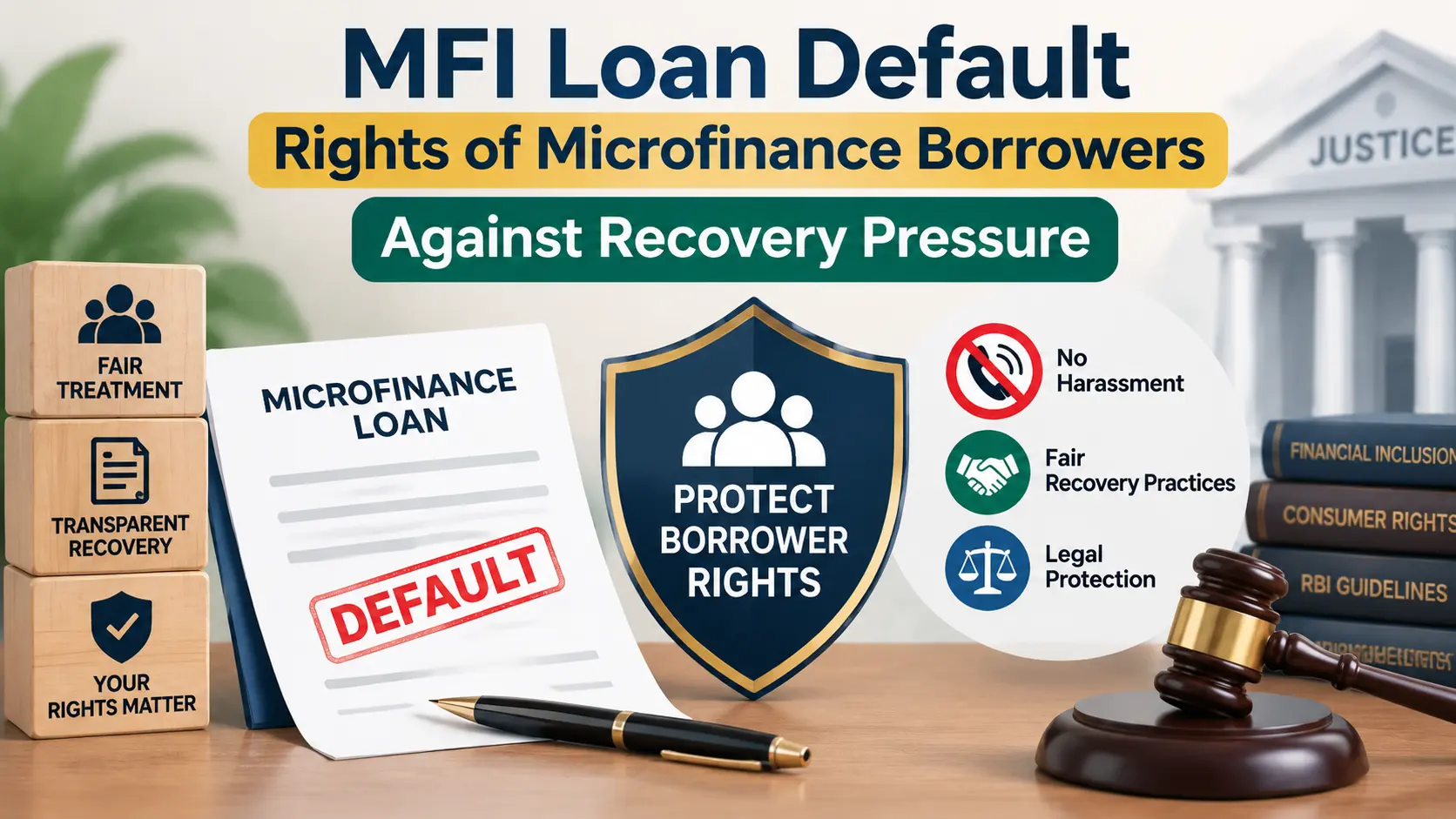
MFI Loan Default Rights of Microfinance Borrowers Against Recovery Pressure
A default on a microfinance instalment can quickly spiral into much more than a monetary issue. Borrowers can find themselves on the receiving end of incessant phone calls, centre meetings, home visits, intimidation in front of neighbours, and communication to family members. Social pressure against women borrowers, SHG members and Joint Liability Group borrowers can sometimes rival the stress of the pending amount.
Loan default does not erase the debt owed, but it doesn't allow a lender or recovery agent to pressure a borrower without limits. Indian microfinance regulation allows creditors to recover their loans, but also draws a line between acceptable recovery and abusive recovery practices. Borrowers deserve to know both halves of that statement: yes, they must repay what they owe, but they are also entitled to their dignity, privacy, fair treatment and right to lodge a complaint.
One tip Advocate BK Singh of Loan Settlement Agency recommends to borrowers is to break these questions into three parts at the start: how much money is actually owed, if the recovery practices being used are legal, and what actual repayment or settlement offer can be put into writing. Filing a complaint about recovery harassment is different than requesting a loan settlement.
Borrowers in Delhi NCR, Delhi, Noida, Ghaziabad, Greater Noida, Gurugram, Faridabad, Lucknow, Jaipur, Mumbai, Pune, Bengaluru, Hyderabad, Kolkata, Ahmedabad and other cities in India can access the same basic RBI guidelines if a lender is regulated, but the exact policies of each lender and available remedies can differ on a case-by-case basis.
Why MFI Loan Default Matters in India in 2026
Microfinance typically involves small-scale collateral-free credit taken by low-income households for the purposes of livelihood, consumption/emergency or microenterprise activities. Under the existing RBI regulations on microfinance, a microfinance loan is defined as an unsecured loan made to a household with annual income less than ₹3,00,000. Under RBI's framework, lenders have to assess borrowers' household indebtedness, and monthly instalment payments are capped at 50% of monthly household income.
Default can impact future access to credit, credit reporting, household liquidity and dynamics with neighbours and peers in group lending models. Debt collection practices can become an issue where normal repayment reminders escalate into harassment, shame tactics, misinformation, incessant phone calls or harassment of family members and employers. BK Singh of Loan Settlement Agency advises distressed borrowers not to treat every phone call or text message as a legal demand notice. Borrowers should validate identity of the caller/messenger, check the microfinance account number, lender name, if the recovery agent is authorised by the lender and then read the demand carefully.
Quick Facts
- MFI loan default does not imply waiver/extinguishment of debt.
- Loan recovery from borrowers by RBI regulated microfinance lenders has to be fair.
- Use of abusive language, mental harassment to borrower and his/her family members may constitute unfair recovery practices.
- Recovery calls before 9:00 a.m. or after 6:00 p.m. have been explicitly mentioned as harsh practice by RBI in microfinance regulations.
- Microfinance lenders cannot absolve themselves from compliance by outsourcing recovery operations.
- Resolution of a recovery related grievance is not treated the same as settlement, restructuring or waiver request.
- Retention of payment acknowledgements/calls recordings/lender's written correspondence may help build evidence.
Which RBI Rules Protect Microfinance Borrowers?
The RBI guidelines titled "Regulatory Framework for Microfinance Loans by the specified Responsible Entities" is applicable to all regulated entities such as commercial banks, the specified co-operative banks and NBFCs (including NBFC-MFIs). Covered topics include household income verification, indebtedness, pricing, repayment terms, borrower communication practices and recovery conduct.
The RBI mandates that regulated entities implement a system to identify borrowers who may be experiencing difficulty due to repayment and proactively communicate with them and advise on the remedies available. Guidance is also provided on where collections can take place and how those in the field should conduct collections.
Loan Settlement Agency Advocate BK Singh recommends documenting all evidence if stern collection efforts become harassment, shame or incessant botheration.
Who Needs This Guidance?
The tips shared here can benefit women borrowers, SHG members or JLG borrowers, street vendors/ home based workers/ small traders/ daily-wage households and salaried families dealing with multiple small loans.
One financial shock can impact multiple EMIs. Hospitalisation expenses/income loss/unpredictable lean season for businesses/farms/no crop or sudden family crisis or partial income can make you skip weekly/monthly repayment, despite your best intentions to keep up with the account.
BK Singh, Advocate at Loan Settlement Agency suggests keeping a separate lender-wise record if you have multiple loans. Include the loan number, pending amount, EMI payments done and collection calls made.
What Should a Borrower Do After an MFI Loan Default?
Begin with the facts of the loan and not the pressure tactics used by the collector. Note down who is trying to collect from you, your loan number, the amount approved, the number of EMIs and how many EMIs have already been paid and what amount they are asking you to pay now.
UPI transactions/receipts, electronic statements/records, cheque transactions and cash pick up receipts are to be matched with the lenders ledger entry. Any discrepancy, if found put it down on paper.
State your inability to pay in a clear manner too. Whether it's more time needed, negotiating EMI, interest waiver on certain fees or settlement; the option is available to the borrower as per the lenders terms and conditions and his approval.
Should the recovery methods turn harassment, note down that too separately. Phone call recordings/screenshots, messages, date-wise visits, branch staff involved and witnesses(if any) will be proof of what transpired.
Borrowers looking at a settlement closure can refer to the verified MFI Settlement Services page. Loan Settlement Professional BK Singh also advises borrowers not to pay an alleged settlement amount if its based only on a verbal agreement. If settlement is granted, have the amount and terms of closure in writing before making the payment.
Documents and Evidence Checklist
Documentation becomes useful if there is any recovery pressure/conflict and you want to communicate with the lender. Helpful documents are:
- Loan contract/sanction letter
- Loan card/ repayment schedule
- KYC documents provided at the time of loan processing
- Receipts of Instalment payments made
- Bank statements reflecting the repayments
- SMS/emails/printed communications received from the lender
Keeping a record of the above enables you to have a clear picture of what happened over the period of your account. Many issues turn murky because the borrower doesn't keep a record of proof of payments or communication.
When Should You Consult a Lawyer or Borrower Representative?
Advice is valuable where the bona fide of the prominent individual is challenged, numerous MFI advances are being bundled together, legal notices have been received or the borrower is harassed to pay-up without any written terms of settlement.
Advice may also be needed if field officials are calling up the borrower's employer, family members or neighbors repeatedly, if coercion or harassment is alleged or if there is uncertainty if a proposed settlement amount will fully settle the account.
BK Singh, Advocate at Loan Settlement Agency can analyze payment history, recovery correspondence, notices and waiver documents to determine the issue at hand and draft a suitable reply.
The aim should be to provide proof, clarity and a practical solution instead of engaging in an unnecessary confrontation.
How Loan Settlement Agency Can Help
Loan Settlement Agency is a third party borrower support platform specializing in loan settlement counseling, loan repayment issues, MFI recovery harassment and registering grievances.
Their authenticated Loan Settlement Consultation page offers help with reviewing your account, corresponding with lenders in writing, settlement negotiation and recovery/harassment issues.
Loan Settlement Agency's BK Singh can guide borrowers through the process of examining your repayment history, financial hardships, communications with recovery agents and offers of settlements. No discounted settlement, waiver or specific payment plan can be promised as each lender will make the decision based on your account.
Frequently Asked Questions
1. If I default in an MFI loan, will it be recorded against my name?
Loan default will get reflected in your credit record and repayment history. However, this does not take away the borrower's rights against abusive recovery practices.
2. Are MFI recovery agents allowed to harass borrowers?
Loan agents are not allowed to resort to threats, abuse, humiliation or any unlawful means to recover loans.
3. Can I settle an MFI loan after defaulting?
Settlement of dues is possible when the lender considers your situation and account-specific conditions and agrees to negotiate.
4. What are the documents required for settling an MFI loan?
Typically, documents such as loan details, repayment history, bank statement, payment receipts and records of communication with recovery agents may be useful.
5. Can recovery agents of an MFI contact my family members?
Acts such as unnecessary harassment of family members and publicly embarrassing borrowers at their workplace are not considered fair recovery practices.
6. Can I file a complaint against MFI loan recovery harassment?
Yes, borrowers have the right to file a complaint with the lender's grievance redressal system and the regulator if needed.
7. If I default on a loan, does that mean I will never be able to borrow again?
Loan default will affect your credit score and repayment history which may make it difficult for you to access loans in the future.
8. Will it be fine if I stop answering MFI loan recovery calls?
It is not advisable to avoid the problem in hopes that it will go away. Communicating in writing and maintaining records will help you in such situations.
9. Can a borrower ask for an extension to repay an MFI loan?
The borrower can negotiate with the lender to modify the loan repayment terms. However, lenders are under no obligation to grant the extension.
10. At what stage should I talk to a loan settlement lawyer?
You may consider talking to a lawyer experienced in loan settlement if the harassment due to recovery efforts escalates or if you wish to dispute your dues or negotiate a settlement.
Final Thoughts
Microfinance loan default requires a cool and documented approach. MF customers should confirm dues, retain evidence of payment, document unfair recovery practices and communicate true inability to pay instead of agreeing to make immediate payments under duress.
Indian law does not forgive bona fide debt just because it has become tough to repay. It does mandate licensed lenders to adhere to recovery guidelines and complaint processes.
Loan Settlement Agency advocate BK Singh can help microfinance borrowers who desire calibrated advice on communicating with lenders about loan settlement, MFI recovery abuse and loan repayments.